When you think of industrial coatings, you probably think of large production rolls and how coatings improve their performance. But coatings can do much more than that. Coatings can be used on a wide variety of components in industrial equipment to help address problems such as corrosion, build-up, sticking, wear, and the associated downtime.
At American Roller, our Plasma Coatings™ are used on more than just rolls. We use them for hopper doors, tape clamp inserts, copper bus bars, precision thrust plates, and all sorts of other components where there’s a surface challenge to be solved in a range of different industries and applications.
The right coating can improve performance, reduce maintenance, and increase production-line reliability.
More Than Rolls: Coatings for the Parts That Keep Production Moving
Every manufacturing process has its own set of problems. A component that’s going to be exposed to aggressive cleaning chemicals is going to have different requirements than one that’s going to be used to guide a very delicate material or to move product through the system.
That’s why coating selection is important. The right coating for the application and operating conditions can help solve specific performance problems and improve equipment reliability.
Here are a few examples of how American Roller’s Plasma Coatings™ can help solve some very real manufacturing problems.
Fighting Corrosion in Demanding Environments
The challenge: Corrosion caused by frequent cleaning and chemical exposure.
In the food and beverage industry, equipment used to make bag seals is used in a very harsh washdown environment. The seal bands are constantly being blasted with high-pressure water, hot water, and cleaning chemicals. This increases corrosion, maintenance needs, and downtime.
The coating solution: PC-300
American Roller’s PC-300 coating adds protection and corrosion resistance to seal bands. It protects components subject to the rigors of cleaning, reducing maintenance needs and minimizing downtime. Corrosion is also an issue in medical equipment manufacturing. The copper bus bars used as electrical interconnects in hospital equipment must withstand exposure to a range of corrosive chemicals and solvents during manufacturing.

The coating solution: PC-500H
Applied to copper bus bars, PC-500H helps the components last longer on the production line, reducing maintenance and downtime.
These are examples of how the correct coating can be used to protect key components in an environment where there is continual exposure to chemicals, and the components are also regularly cleaned.

Improving Product Release and Preventing Material Buildup
The challenge: Materials sticking to equipment instead of moving freely.
When materials adhere to the production equipment, the result can be more than just a messy component. Build-up and poor release can disrupt material flow, require extra cleaning, and slow production.
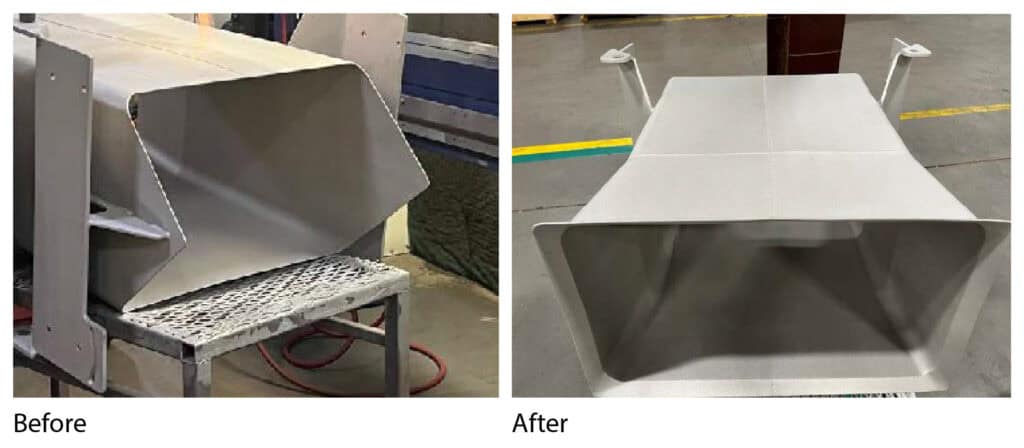
In pellet production, the pellets go through the hoppers, are compacted, and then conveyed on a belt to the next stage. The hopper doors, brackets, and all associated bits need a surface that lets the product release and flow through the plant.
The coating solution: PC-915F
American Roller’s PC-915F coating provides the high release that these components require. After coating, the product flows more easily through the parts, reducing downtime and keeping the process running.
A similar problem arises in the case of applications. You have a tape clamp insert which is designed to slide over the circuit strips as the backing is stripped off and the circuits are being cut. If the insert sticks to the strips, it can cause problems.
The coating solution: PC-918C
PC-918C provides a high-release surface that helps tape clamp inserts slide easily over the strips instead of sticking.
Whether you’re handling bulk materials, adhesive-backed products, or delicate production materials, improved release reduces sticking and improves operation.
Protecting Precision Components
The challenge: Maintaining surface durability in applications with extremely tight tolerances.
Not every coating application will involve massive equipment or high-volume material handling. Some components are used in very precise assemblies where even the tiniest dimensional differences are going to be critical.
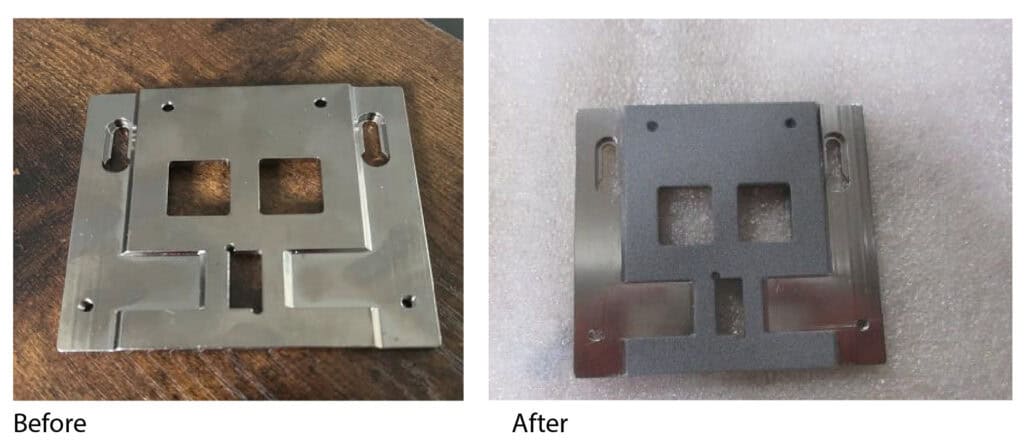
Thrust plates as part of an air bearing assembly are one example. These are part of a rotor assembly which floats on a cushion of air with a gap of about 0.0002″. The spindle accuracy is less than 10 millionths of an inch.
In this application, we wanted a harder coating for the air bearing to improve resilience to improper handling without compromising the assembly’s performance.
The coating solution: PC-15000-LT
PC-15000-LT provides a more robust surface, helping the air bearing withstand minor handling issues.
This application shows the importance of considering the component’s full operating environment when selecting a coating. You must consider precision requirements, surface durability, and assembly requirements.
Balancing Traction and Release
The challenge: Maintaining the traction needed to keep production belts moving reliably.
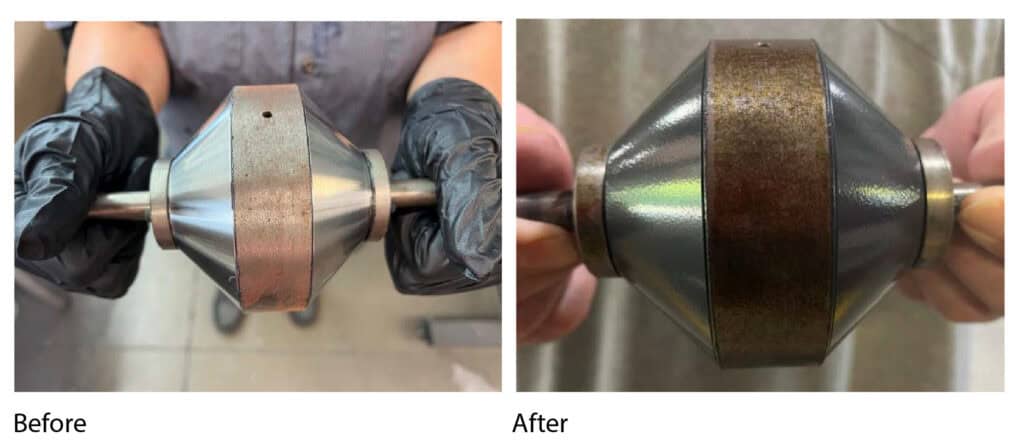
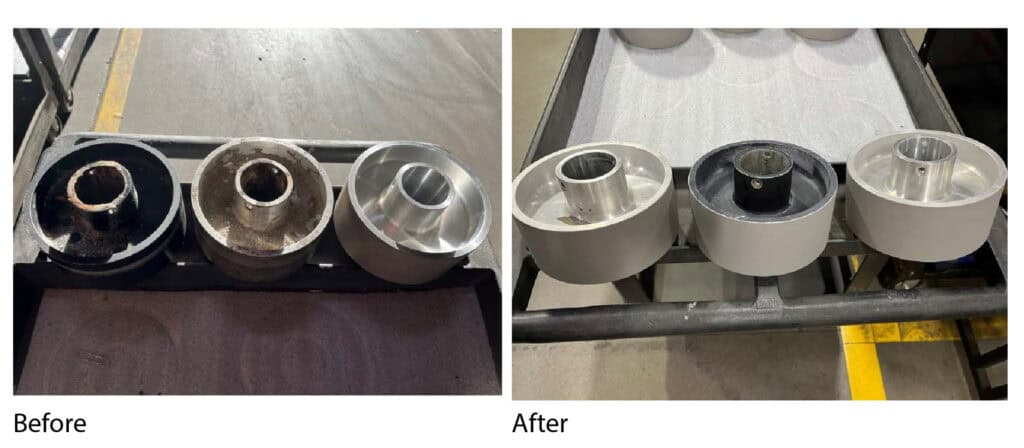
In tissue and towel manufacture, pulleys are fitted at the ends of the mandrels to pull the belt along the line. If mandrels are made without a coating, the pulleys can slip, affecting belt movement and causing production problems.
The coating solution: PC-412
American Roller’s PC-412 coating provides the traction required to help prevent slippage. It improves grip between the pulley and belt, which in turn helps to extend belt life and reduce slippage.
This application shows how the right coating can improve the performance of the smallest of components within a larger manufacturing system. It improves traction at the component level, leading to more reliable operation and less maintenance.
Why Coating the Right Component Matters
A production line consists of many individual components, and a problem with one can affect the whole process. Corrosion, sticking, poor release, and low surface durability can increase maintenance and interrupt production.
Specialized coatings can help by providing the right surface properties for the component, its environment, and its function.
Depending on the application, the benefits may include:
- Improved corrosion resistance: Helps to protect the components that are going to be in contact with water, cleaning chemicals, and the like.
- Better product release: reduces the tendency to stick and helps the materials get through the plant equipment.
- Greater surface durability: provides additional surface protection for components that are subject to handling and operating requirements.
- Reduced maintenance: this will help to extend component life and reduce the requirement for maintenance.
- Less production downtime: Deal with surface-related problems which can lead to production stoppages.
The key is to get to grips with the problem first before you go looking for a solution. The material you’re working with, the operating environment, the level of chemical exposure, and the required surface characteristics will all affect the coating you end up with.
Think Beyond the Roll
Industrial coating solutions aren’t just for the big, obvious bits of your equipment. Improving a smaller component’s performance can make a real difference to the whole manufacturing process.
From corrosion-resistant seal bands and copper bus bars to high-release hopper components and precision thrust plates, American Roller’s Plasma Coatings™ help solve the real problems industrial components face day to day.
If it sticks, if it corrodes, if it wears out prematurely, or if it just causes unnecessary downtime, then it may be worth having a look at the surface of the component.
Got a difficult component or application? Get in touch with American Roller to talk you through your coating requirements and look at a solution that’s been specifically designed to address your production issues.
The right coating can be the difference between working around a problem and working on it at the surface.